More AI models
Read more

Falcon H1R 7B proves small models can reason
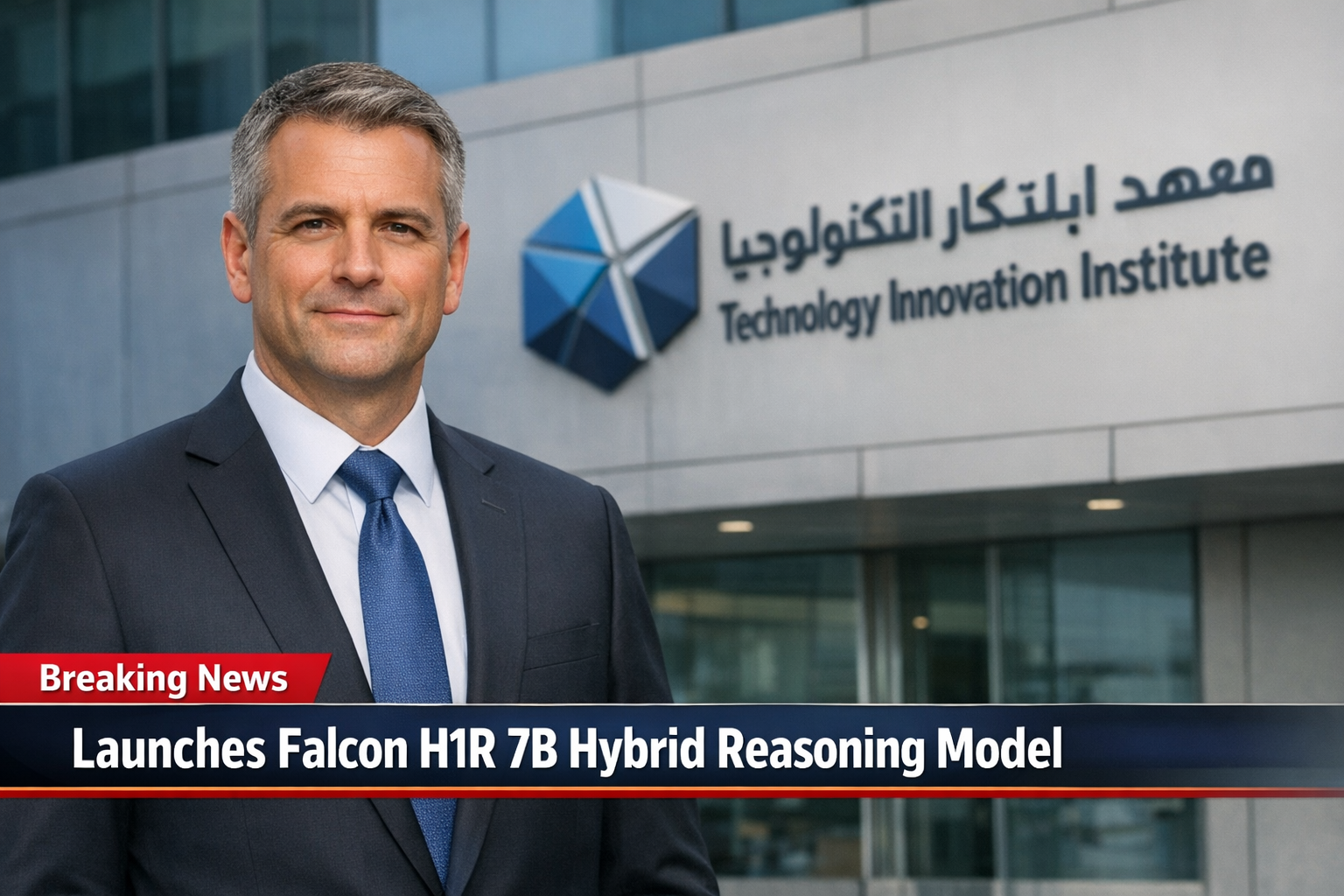

The Technology Innovation Institute (TII) just dropped Falcon H1R 7B, and the headline isn't the parameter count - it's the claim that a 7B model can beat much larger open-weight rivals on hard reasoning. According to Falcon LM blog, TII is pitching Falcon H1R 7B as proof that "better reasoning" doesn't have to mean "bigger model." If you're a business owner trying to turn AI into automation (not science projects), that matters because model size affects cost, speed, and where you can realistically deploy it. This release also shifts the competitive story from brute-force scaling to architecture choices and inference-time tricks that can change the economics of AI workflows.
The last couple of years have trained everyone to assume reasoning improvements come from scaling models up. The article frames Falcon H1R 7B as a direct challenge to that logic. TII's message is basically: "we can get strong reasoning without jumping to 30B, 40B, or bigger."
That claim is backed by comparisons to much larger open models, including Alibaba's Qwen in the 32B and 47B range and Nvidia's Nemotron. From a business point of view, those comparisons are important even if you don't care about leaderboard drama. Bigger models usually mean heavier infrastructure requirements and slower iteration cycles. A smaller model that can handle multi-step reasoning without collapsing can be easier to pilot, easier to scale, and easier to productize.
TII also made the release relatively accessible: the full model code is on Hugging Face, and there's a live chatbot demo. There's also a technical report that explains how they built and trained it, which matters if you or your vendors need to evaluate risk and reproducibility.
The core differentiator in the article is Falcon H1R 7B's "hybrid backbone." Most modern LLMs are transformer-only. Falcon H1R 7B mixes standard transformer attention layers with Mamba, described as a state-space model approach.
Why should you care? Because the article ties the hybrid design to long-sequence efficiency. Transformer attention can get expensive as sequences grow. The hybrid design is presented as a way to keep long reasoning chains practical by scaling more linearly for long sequences, cutting memory and compute pressure.
TII also shares a throughput data point that signals real operational intent: at batch size 64, Falcon H1R 7B reportedly runs around 1,500 tokens per second per GPU, and the article says that's close to twice the speed of models like Qwen3 8B. You don't need to be technical to translate this: if you're generating longer outputs (multi-step plans, detailed troubleshooting, code suggestions, math-heavy explanations), speed and cost can decide whether automation is usable or frustrating.
TII is leaning hard on benchmark results, and the article highlights three areas: math reasoning, coding, and broader reasoning tasks.
On AIME 2025 (a math reasoning benchmark), Falcon H1R 7B is reported at 83.1%. The article positions that as stronger than multiple larger open models, naming Apriel-v1.6-Thinker (15B) and OLMo 3 Think (32B). It also says Falcon H1R 7B closes distance with proprietary systems on math-oriented tasks, mentioning Claude 4.5 Sonnet and Amazon Nova 2.0 Lite as reference points.
In coding, the article calls out 68.6% on LCB v6, with TII claiming it's the top score among all the models they tested, including much larger ones. And on general reasoning, the framing is that Falcon H1R 7B stays competitive with larger models while clearly outperforming similarly sized peers.
The business translation here isn't "your model is 83.1% smart." It's: if these claims hold up in your domain, you may not need to buy your way into reasoning performance with a much bigger model. That can change your unit economics for things like automated quoting, technical support drafts, internal knowledge base assistants, and code generation in product teams.
If you're deciding where Falcon H1R 7B could matter, start with the two constraints most businesses hit first: cost and latency. The article's whole premise is that architectural efficiency can deliver "big model" outcomes without "big model" overhead. If that works in practice, it creates a few concrete openings.
Many automation ideas die because they require long, structured outputs. Think: multi-step troubleshooting runbooks, detailed incident writeups, compliance-friendly explanations, or a full sales proposal draft. The article's emphasis on linear scaling for long reasoning chains and the 1,500 tokens/sec/GPU figure points to a model designed for that workload. In plain terms: you can ask for more detail without waiting forever or burning budget.
The article calls out that many sub-10B models have been fine at conversation but weak at math and logical deduction. Falcon H1R 7B is presented as specifically trained and optimized to do stronger multi-step thinking. That unlocks automations where the model has to work through steps, not just rephrase text. Examples you can pilot without rebuilding your whole company:
The key is that these are "assistive automation" plays. You still keep a human in the loop, but you can realistically cut 12-15 hours/week of repetitive drafting and first-pass analysis across a small team if the model's reasoning holds.
The article says Falcon H1R 7B is optimized for test-time scaling: it can generate multiple reasoning traces in parallel and prune low-confidence paths dynamically, aiming for higher accuracy while using fewer tokens. For you, that's a practical lever. You can run the model in a cheaper "fast mode" for low-risk tasks (summaries, draft emails), and switch to a "multi-trace mode" for higher-risk tasks (math, code, policy-sensitive reasoning) where correctness matters more than speed.
That style of deployment also fits business reality: not everything needs maximum compute. You want knobs you can set per workflow.
You don't have to bet the farm to test whether Falcon H1R 7B is real value or just benchmark hype. The article notes it's available on Hugging Face and can be tried via a chatbot demo, which makes early evaluation straightforward.
Choose tasks where better reasoning directly saves time or reduces rework. Two good starting points:
Define success as something measurable: fewer back-and-forth edits, fewer wrong calculations, or drafts that require only minor cleanup.
Keep the integration simple so you're testing capability, not building a platform.
Set rules: the model produces a draft plus a short "why" section (its reasoning summary) so your team can spot nonsense quickly.
Because the article emphasizes inference-time techniques, treat output quality as configurable. Create two paths:
Also, put a simple human approval step in the loop. For most businesses, that's the difference between "useful automation" and "unplanned liability."
The article says Falcon H1R 7B ships under a custom Falcon LLM License 1.0. It's described as Apache 2.0-based, but not a clean "anything goes" license. You can use it commercially and it's royalty-free, but there are obligations and restrictions.
The license requires attribution and includes a non-litigation commitment (you agree not to sue TII). There's also an Acceptable Use Policy that bans categories like illegal activity, harm, disinformation, and harassment, and the article says violations automatically end your license.
For your business, that means you should treat adoption like any other vendor risk decision. Before you wire Falcon H1R 7B into customer-facing products, decide who owns compliance, how you'll monitor use cases, and what happens if your use accidentally crosses a prohibited line. "Open weights" doesn't automatically mean "no strings." This release is a good reminder.
The bigger shift in the article isn't just "TII released a model." It's that the competitive battlefield moves toward architectural efficiency and inference-time scaling rather than raw parameter count. If Falcon H1R 7B's approach holds up, you should expect more vendors and open-weight teams to focus on hybrid backbones, throughput, and test-time strategies that let smaller models punch above their weight.
For you, that likely means two things over the next year: first, more "reasoning-grade" automation becomes affordable without jumping to massive models; second, evaluation will get harder because you'll be comparing not just models, but also how they run at inference time.
Source: Falcon LM blog
Want to stay ahead of automation trends? StratusAI tracks changes like Falcon H1R 7B so you can make practical decisions, not guess. If you want help picking the right pilot workflow and setting up a safe approval loop, we can map it out quickly.


.png)


