More AI models
Read more

AI-assisted coding at Egnyte keeps junior hiring
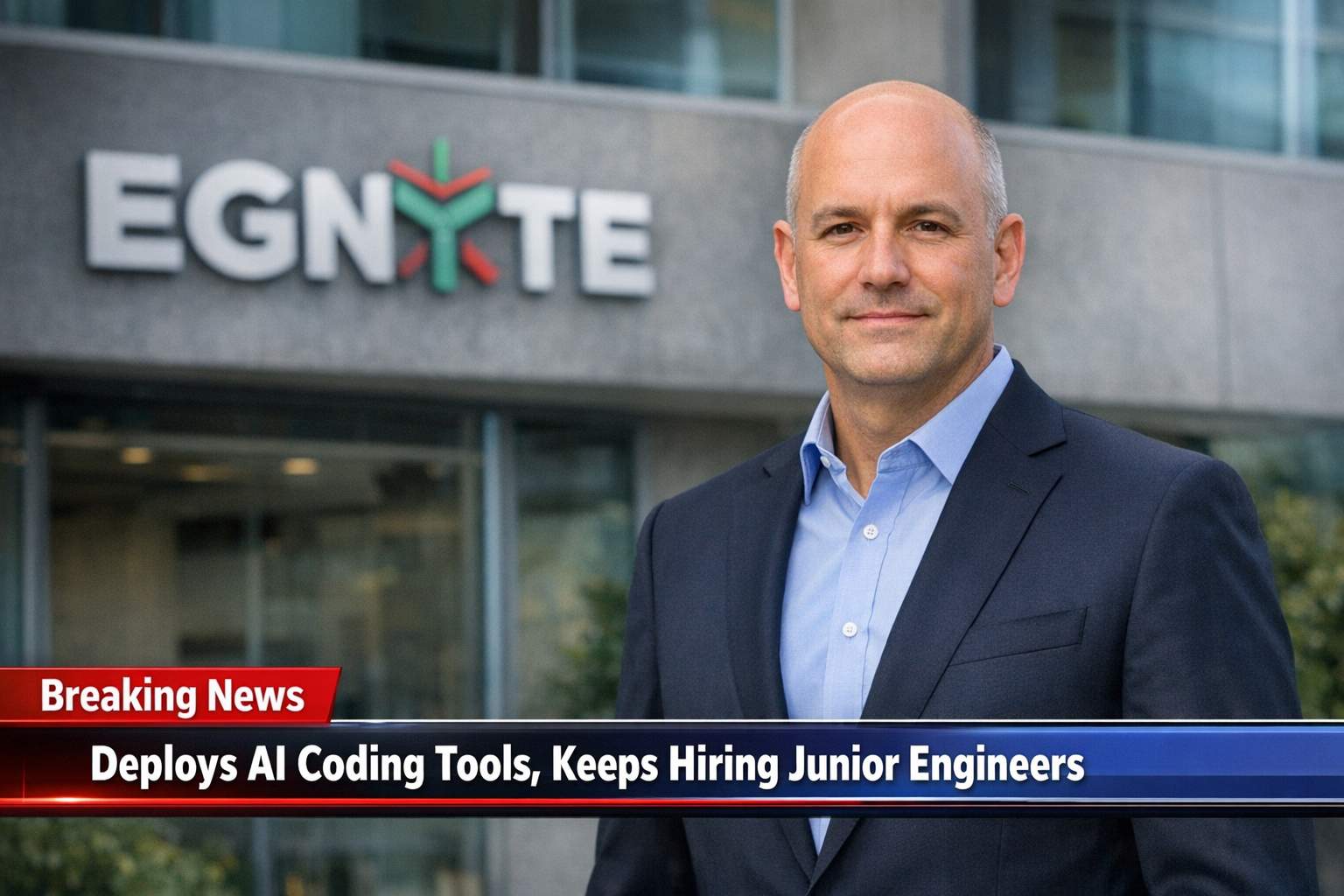

Egnyte is putting a clear stake in the ground on AI-assisted coding: use AI to amplify engineers, not replace them. According to VentureBeat, the $1.5 billion cloud content governance company has embedded multiple AI coding tools across its global team of more than 350 developers, while continuing to hire junior engineers. The point isn’t headcount reduction - it’s faster onboarding, quicker codebase fluency, and a shorter runway from junior contributor to senior impact. For you as a business owner, that matters because it reframes AI from “cost cutting” to “capacity building,” with accountability still sitting with humans.
Egnyte’s engineering org is using several AI coding tools across day-to-day development: Claude Code, Cursor, Augment, and Gemini CLI. The article describes these tools being applied to practical, recurring work like pulling up information quickly, understanding unfamiliar areas of the code, searching and locating relevant code, and summarizing changes. Egnyte’s environment includes a sizable Java-heavy codebase with many libraries and version combinations, which is exactly the kind of “context jungle” that can slow down even experienced engineers when they move between repositories.
One of the clearest examples in the article is how AI helps engineers orient themselves in domains they don’t know well. If someone is digging into an iOS application without deep iOS experience, they can use an AI CLI tool to explore the repo and map what matters faster than they could through manual spelunking. Another expanding pattern is automatic pull request summaries that describe what changed and why, which can reduce review friction and help reviewers spend their attention on correctness and risk instead of reading every line cold.
Egnyte is also using AI beyond engineering. Product and UX teams can generate prototypes and interface variations so engineers get tangible artifacts rather than abstract descriptions. That shifts engineering conversations from “what do you mean?” to “which version do we ship?”
The most important part of Egnyte’s approach is what it won’t do. Egnyte isn’t treating AI like an autonomous teammate that ships to production. The CTO’s stance, as described in the article, is that changes must be owned by the developer, and commits still move through human review, security validation, and escalation when anything is flagged. That framing is more than culture - it’s risk management.
In practical business terms, this is “human in the loop” applied to software delivery:
The article also calls out a realistic limitation: models may not be trained on a company’s highly specific infrastructure components. So even if an AI tool outputs something that looks plausible, it can be wrong in subtle ways that only show up at runtime, under load, or in production-only environments. That’s why Egnyte warns developers not to go on autopilot or blindly trust generated output.
Unit testing is another example of the same mindset. AI can help generate unit tests and validate components in isolation, but it’s treated as a productivity boost, not a guarantee of quality. That’s an important nuance if you’re trying to estimate how AI changes delivery timelines: it can compress work, but it doesn’t erase the need for judgment, review, and accountability.
Egnyte’s decision to keep hiring junior engineers is the most business-relevant takeaway, because it addresses a quiet problem many companies will create if they chase short-term “AI efficiency” too hard: you can hollow out your future leadership pipeline.
In the article, the CTO links junior hiring to succession planning - juniors become seniors, and seniors carry architectural knowledge and long-horizon decision-making. If you stop hiring juniors because “AI can do it,” you risk a future where:
Egnyte’s approach suggests a different ROI model for AI coding tools. Instead of measuring value purely as “fewer engineers needed,” you measure it as:
There’s also an organizational change hidden in plain sight: the expectation for juniors is rising. The article says Egnyte juniors participate in requirement analysis, deployment, productization, and post-deployment maintenance - not just coding tickets. If AI reduces some of the “where is this code?” and “what does this function do?” overhead, you can pull juniors into real ownership earlier, which can increase retention and accelerate capability growth.
For you, even if you don’t run a 350-person developer org, the pattern is transferable. Any business with specialized workflows has a similar pipeline problem: the “junior” role (support reps, coordinators, analysts) often becomes the future “senior” role (team lead, ops manager, systems owner). If you use AI strictly to eliminate entry-level roles, you may win this quarter and lose next year.
The article also highlights a pragmatic adoption dynamic: juniors often embrace new tools quickly, while seniors can be more cautious because they’ve seen tool hype go wrong before. Egnyte responds with incremental adoption, effectively using seniors as a safety constraint and juniors as a catalyst. That mix can be a competitive advantage if it keeps experimentation high without letting quality slip.
Egnyte’s implementation points to automation opportunities that aren’t about turning your business into a software company. They’re about compressing “time to understanding” and reducing rework.
Egnyte engineers use tools like Gemini CLI and Augment for discovery and code lookup. The business analogue is making it easier for your team to find the right SOP, policy, customer history, or checklist without pinging a manager 10 times. The goal is the same: fewer context switches, faster decisions.
Pull request summaries are basically “change summaries for busy reviewers.” In operations, that translates to standardized summaries for anything that needs approval: a vendor change, a pricing adjustment, a customer exception, or a website update. Summaries don’t replace approvals - they make them faster and more consistent.
Egnyte’s rule is that developers own the change, and AI isn’t trusted to commit to production. Your version might be: AI can draft customer emails, but a human hits send; AI can propose invoice categorizations, but finance approves; AI can suggest answers, but support confirms accuracy.
Egnyte’s product and UX teams are generating prototypes and interface variations so engineering gets concrete artifacts. The broader business win is reducing ambiguity before you invest time and money. If you can show a draft flow, form, or UI variation earlier, you reduce costly rebuilds later.
You don’t need Egnyte’s scale to adopt the same operating model. Here’s a practical rollout plan based on what the article describes, adapted for a business setting where you want faster throughput without losing control.
The point isn’t to adopt every tool mentioned in the article. It’s to adopt the posture: speed up understanding and iteration, while keeping human ownership and review as non-negotiable.
Egnyte’s CTO pushes back on the idea that AI makes developers obsolete, and he frames the practice as AI-assisted coding rather than hypey labels. That signals a direction you should plan for: AI will likely keep raising the baseline expectations for what one person can deliver, but it won’t remove the need for training, judgment, and internal successors.
If Egnyte is right, the winners won’t be the companies that cut the deepest. They’ll be the ones that treat AI as core infrastructure for learning curves, onboarding, and collaboration, while still protecting production quality with human accountability.
Source: VentureBeat
Want to stay ahead of automation trends? StratusAI keeps your business on the cutting edge with practical guidance on where automation helps and where human review still pays off. If you want a plan that fits your team size and risk tolerance, we can map it out together and prioritize the first workflows to streamline without breaking what already works.


.png)


